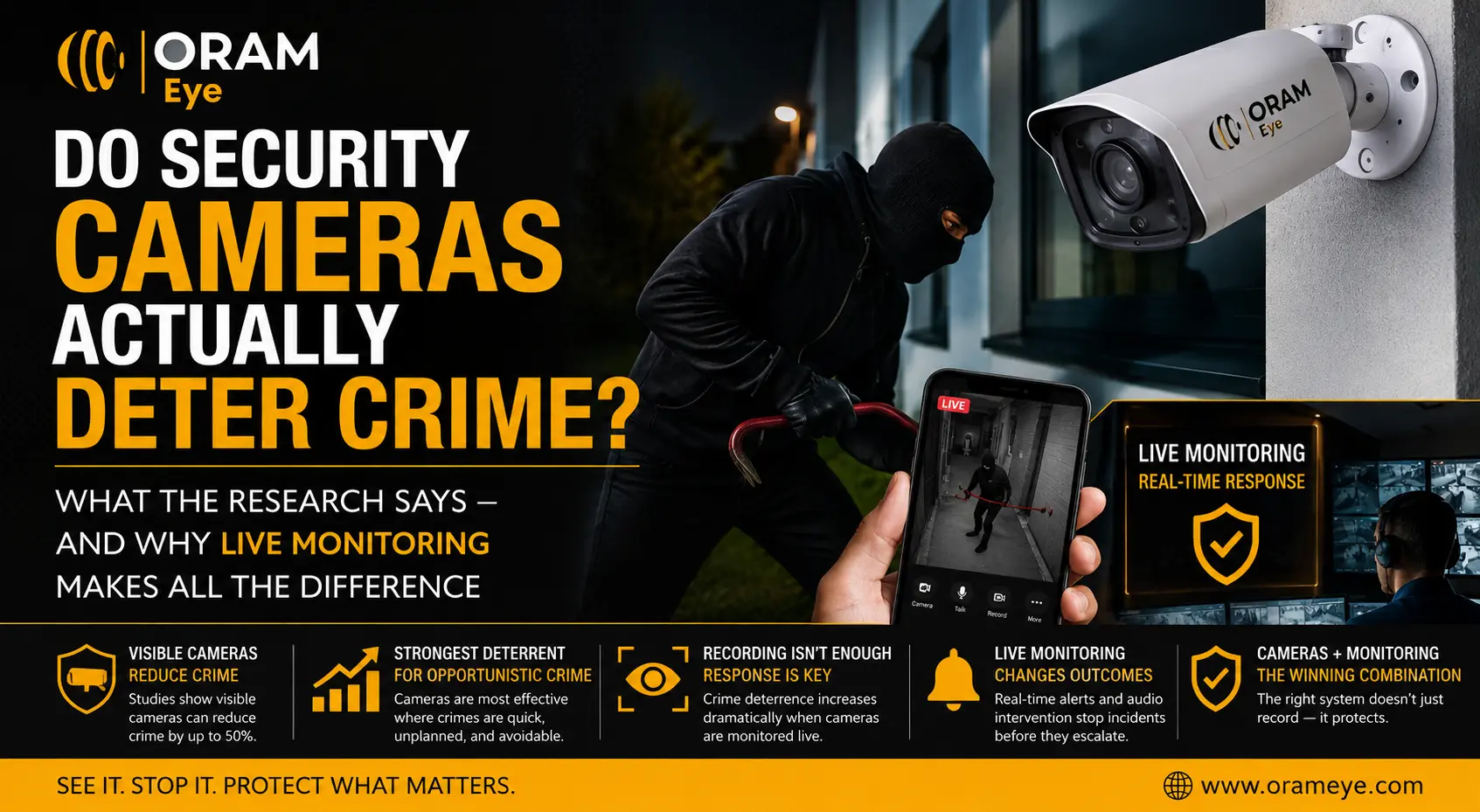
What the Research Says — And Why Live Monitoring Makes All the Difference
Every business owner who installs a security camera asks the same question: will this actually stop something from happening, or will it just record the moment everything goes wrong? It is one of the most searched topics in security — and for good reason. The answer matters enormously for how you spend your security budget.
This article looks at what real research and crime data tell us about CCTV deterrence, which situations cameras work best in, where they fall short — and why live camera monitoring is the factor that turns a passive recording device into an active crime-prevention tool.
📌 Quick Answer Yes — security cameras do deter crime, but only under specific conditions. Visibility, lighting, and whether cameras are actively monitored are the three factors that determine how effective they are. A camera no one is watching is a recording device. A camera with a trained team behind it is a deterrent.
What Does the Research Actually Say?
Studies on CCTV and crime prevention consistently show a positive deterrence effect — but with important caveats. Here is what the evidence tells us:
A widely cited review of over 40 CCTV studies found that security cameras reduced crime by an average of 16% in areas where they were deployed. The effect was strongest in contained, monitored environments such as car parks, transport hubs, and commercial properties — and weakest in open public spaces where cameras were less visible or known.
1. Cameras Reduce Crime in Targeted Areas
For businesses specifically — retail stores, warehouses, office buildings — the deterrence effect is significantly higher because the camera coverage is concentrated, signage is visible, and potential offenders understand they are being observed in a controlled space.
2. Visibility Is the #1 Factor
Deterrence only works when a potential offender knows the camera is there. Research consistently confirms that visible, well-positioned cameras — ideally accompanied by clear signage — are far more effective than hidden or poorly placed ones. A criminal planning a break-in will assess the property in advance. A visible camera (especially one with a monitoring notice) dramatically increases the perceived risk of getting caught.
3. The ‘Displacement Effect’ — A Real But Limited Concern
Critics of CCTV often point to displacement: the idea that cameras simply push crime to areas without cameras rather than preventing it. Research does show some displacement occurs, but studies also consistently find a ‘diffusion of benefit’ — crime reduction often spills over into nearby unmonitored areas, because offenders cannot easily tell where surveillance ends.
For business owners, displacement is largely irrelevant: your goal is to protect your specific property, and cameras demonstrably do that.
4. Cameras Alone Have a Ceiling
Here is the honest part: cameras that simply record — with no one watching — have a limited deterrence ceiling. A determined or professional criminal knows that recorded footage only leads to consequences if they are identified and caught after the fact — which in many theft and burglary cases, does not happen. This is why research increasingly points to active monitoring as the critical variable that unlocks cameras’ full deterrence potential.
Which Types of Crime Do Cameras Deter Most Effectively?
Not all crime is equally deterred by CCTV. Understanding this helps businesses invest in the right combination of security measures.
High Deterrence (Cameras Work Very Well)
- Opportunistic theft — shoplifters, package theft, smash-and-grab
- Vandalism and graffiti — visible cameras dramatically reduce these
- After-hours break-ins — especially when monitoring signage is displayed
- Vehicle theft and parking lot crime — one of the strongest evidence bases
- Loitering and trespassing — can be interrupted in real time with audio alerts
Moderate Deterrence (Cameras Help But Need Support)
- Organised retail theft (ORC) — professional groups are aware of cameras but monitoring raises the risk calculus
- Internal employee theft — cameras help but require clear HR policies and monitoring protocols
- Fraud at point-of-sale — cameras support investigation but POS system integration adds more power
Lower Deterrence (Cameras Are Not Enough Alone)
- Violent crime in high-risk environments — cameras document but rarely prevent in the moment without active response
- Cybercrime and data theft — physical cameras offer no protection here
| 💡 Key InsightFor the crimes most businesses actually face — opportunistic theft, after-hours break-ins, vandalism, and trespassing — security cameras with live monitoring are among the most effective tools available, consistently outperforming passive recording systems. |
Why Live Camera Monitoring Changes Everything
The single biggest upgrade you can make to any CCTV system is adding professional live monitoring — a trained team watching your cameras in real time, around the clock. Here is exactly why it transforms deterrence and response:
From Passive Recording to Active Protection
A camera that records crime creates evidence. A camera that is actively monitored prevents crime from completing. When a monitoring team detects a threat — an intruder, a person loitering at a loading bay, or an after-hours movement in a restricted zone — they can intervene within seconds: alerting you, triggering an audio warning, or calling law enforcement with a live video feed to support faster dispatch.
This is the core difference between a security camera and a security system.
How Visible Monitoring Signs Amplify Deterrence
Properties displaying professional monitoring notices — such as “This property is under 24/7 live surveillance by OramEye” — signal to potential offenders that someone is watching right now, not just recording. Research on burglary prevention consistently shows that perceived detection risk is the primary factor in a criminal’s decision to proceed or abort. Monitored cameras dramatically raise that perceived risk.
The Response Speed Advantage
With recorded-only CCTV, the typical response chain is: incident occurs → footage reviewed the next day → police report filed → low chance of recovery. With live monitoring, the chain becomes: suspicious activity detected → monitoring team verifies in seconds → law enforcement called during the incident with a live feed → far higher chance of intervention and apprehension.
For businesses, this speed difference is the gap between a prevented loss and an insurance claim.
| Factor | Cameras Only (No Monitoring) | Cameras + Live Monitoring |
|---|---|---|
| Crime deterrence | Moderate — depends on visibility | Very High — known to be actively watched |
| Response speed | None — footage reviewed after event | Seconds — team acts in real time |
| False alarm filtering | Not applicable | ✅ Human verifies before escalating |
| Evidence quality | Recorded only | Live + Recorded |
| Law enforcement call | After discovery | During the incident with live feed |
| Night/weekend coverage | Records but no one watching | 24/7 active human oversight |
| Cost vs. security guard | Low hardware cost | 60–80% cheaper than on-site guards |
| Suitable for | Low-risk, small premises | Retail, warehouses, offices, multi-site |
| 🔗 OramEye Live Monitoring OramEye provides professional 24/7 live CCTV monitoring for businesses in the USA, Canada, and the Netherlands — connecting to your existing cameras with no new hardware required in most cases.Learn more: orameye.com/live-cctv-monitoringCamera monitoring service: orameye.com/camera-monitoring-service |
5 Things That Make Your CCTV System More Effective
Whether you already have cameras or are planning to install them, these five factors determine how much deterrence value you actually get:
1. Camera Placement — Cover What Matters Most
Position cameras at all entry and exit points, loading bays, cash handling areas, and high-value storage zones. Ensure cameras are mounted at a height that captures facial detail (roughly 2.5–3.5 metres), not so high that footage becomes useless for identification.
2. Visible Signage — Let People Know
Do not hide the fact that you have cameras. Visible CCTV signage at entrances and key areas is both a legal requirement in many jurisdictions and a proven deterrence multiplier. For monitored properties, signage specifically stating that footage is actively reviewed raises deterrence further.
3. Good Lighting — Night Coverage Is Non-Negotiable
The majority of commercial break-ins occur at night or during low-light conditions. Cameras without adequate night vision — or without supporting lighting — produce footage that is effectively useless for identification. Ensure all exterior cameras have either colour night vision capability or are paired with infrared-compatible lighting.
4. Reliable Internet Connection — Essential for Remote Monitoring
For live monitoring to function, your cameras need a stable, high-speed internet connection. A dropped connection during an incident is a critical failure point. Ensure your network setup is robust, with a backup 4G/LTE failover if possible for high-risk properties.
5. Active Monitoring — The Force Multiplier
As detailed above, pairing cameras with a professional monitoring service is the single highest-impact upgrade available. It converts your CCTV investment from a documentation tool into a real-time security system. OramEye monitoring service works with your existing IP cameras — making it one of the most cost-effective upgrades a business can make. See: orameye.com/camera-monitoring-service
Does CCTV Deter Crime Differently by Region?
Yes — crime patterns, types of theft, and the business environments in the USA, Canada, and Netherlands each present slightly different surveillance challenges.
🇺🇸 USA
Commercial burglary and retail theft are among the top security concerns for US businesses, with the National Retail Federation estimating retail shrinkage at nearly $100 billion annually. Live camera monitoring is increasingly standard for mid-size and large retailers. OramEye’s US monitoring service covers all 50 states with real-time law enforcement coordination.
🇨🇦 Canada
Organised retail crime and warehouse theft are growing concerns across Canada’s major cities. Canadian businesses benefit from CCTV systems that are PIPEDA-compliant and supported by monitoring teams familiar with local law enforcement protocols. OramEye covers Toronto, Vancouver, Calgary, Montreal, and Ottawa.
🇳🇱 Netherlands
Dutch businesses operate under GDPR/AVG, which requires clear signage, limited data retention, and documented purpose for surveillance. OramEye’s Netherlands monitoring service is fully AVG-compliant, with Dutch-language support.
Frequently Asked Questions
These questions are structured to appear in Google’s People Also Ask, Featured Snippets, and AI-generated search results.
Do security cameras actually deter crime?
Yes. Research consistently shows security cameras reduce crime by 13–20% in targeted areas. The effect is strongest for opportunistic theft, vandalism, and after-hours break-ins. Deterrence is significantly amplified when cameras are visible, well-lit, and actively monitored by a professional team.
Do security cameras deter burglars?
Yes — studies show that visible security cameras are one of the top factors burglars consider before targeting a property. A 2012 UNC study found that 83% of convicted burglars said they would look for signs of cameras before breaking in, and the majority said cameras would cause them to choose a different target.
What is more effective — security cameras or security guards?
Both have strengths, but live CCTV monitoring offers equivalent deterrence at 60–80% lower cost than employing on-site security guards. Monitoring covers multiple sites simultaneously, operates 24/7 with no shift gaps, and provides law enforcement with live video during incidents. Many businesses use a hybrid approach: guards during business hours, live monitoring after hours.
Do fake security cameras deter crime?
Fake cameras can provide minimal deterrence against completely uninformed opportunistic criminals, but they offer no real protection. Experienced criminals can identify dummy cameras easily. Fake cameras also provide no evidence, no monitoring, and no response capability — meaning once a determined criminal realises there is no real monitoring, your property is fully exposed.
Does live CCTV monitoring reduce false alarms?
Yes — significantly. Automated motion sensors frequently trigger false alarms from animals, shadows, or weather. With live monitoring, a trained operator verifies every alert before escalating it, reducing false alarm rates by up to 90% compared to automated-only systems. This saves businesses from unnecessary police call-out fees and alarm fatigue.
Ready to Make Your Cameras Work Harder?
If you already have security cameras installed at your business, adding live monitoring is the single most impactful upgrade you can make. OramEye connects to your existing IP cameras with no new hardware required in most cases — and provides 24/7 professional monitoring for businesses across the USA, Canada, and the Netherlands.
Related articles on OramEye:
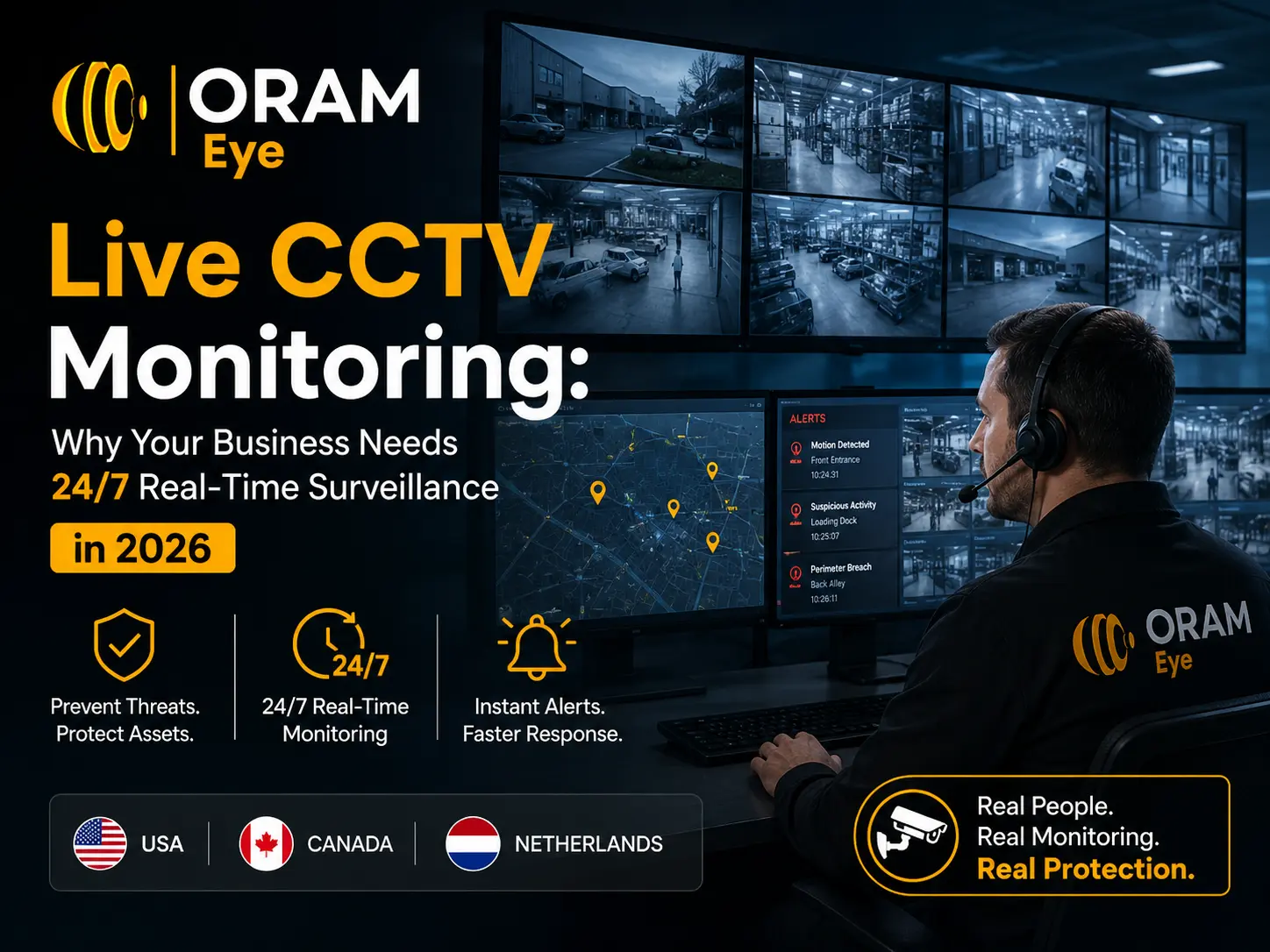
- Live CCTV Monitoring: Why Your Business Needs 24/7 Surveillance → orameye.com/live-cctv-monitoring-247-real-time-surveillance
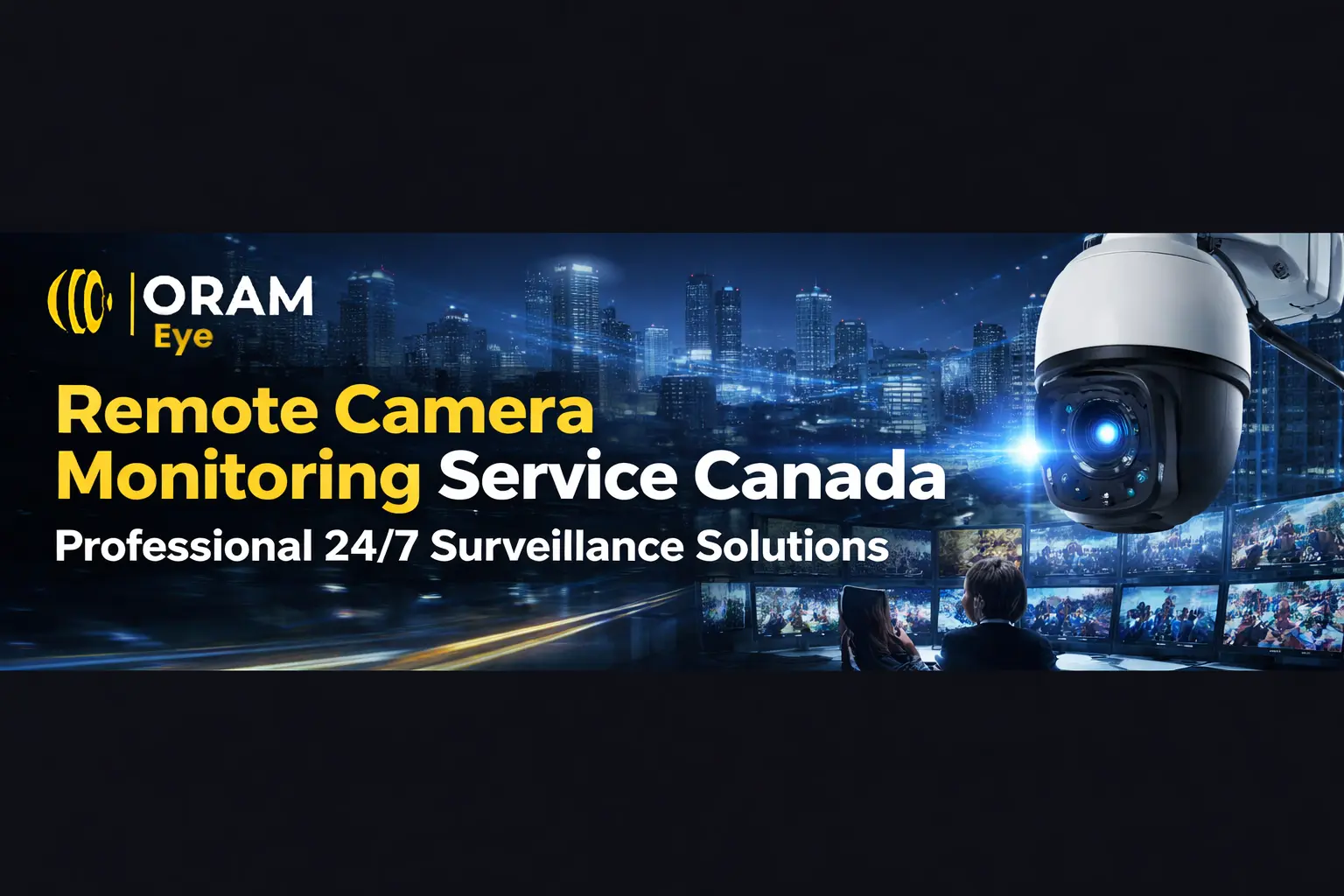
- Remote Camera Monitoring Service Canada → orameye.com/remote-camera-monitoring-service-canada
- Why Live Security Camera Monitoring Is a Game-Changer → orameye.com/why-live-security-camera-monitoring-is-a-game-changer
- Enhancing Business Security with Live Surveillance → orameye.com/enhancing-business-security-with-live-surveillance-monitoring